

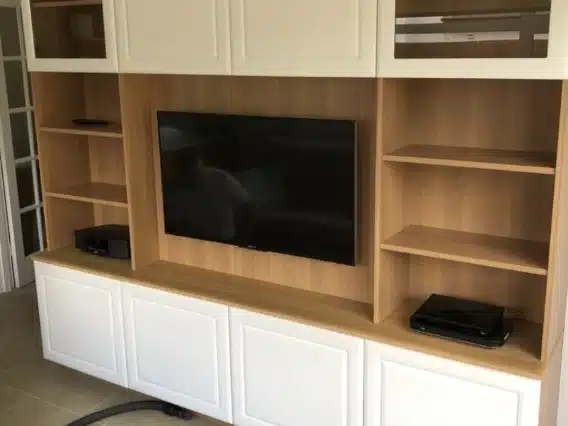
If you’re deciding between a TV stand and a fitted media unit, start by looking at what you truly need the furniture to accomplish. Do you simply need a sturdy, stylish place to position your television, or are you looking to create a dedicated home for media players, game consoles, soundbars, books, and the everyday items currently cluttering your living area?
A standalone TV stand suits a straightforward, flexible setup and gives you the freedom to rearrange or move it whenever you like. On the other hand, a custom-fitted media unit makes much more sense when you want integrated storage designed specifically around your AV equipment and the precise dimensions of your room. Neither option is inherently superior—and opting for fitted furniture doesn’t mean you have to cover an entire wall from floor to ceiling.
This guide will help you weigh up both options so you can choose a suitable media storage solution for your space and lifestyle.
TV Stand or Media Unit: The Main Difference
| What to compare | Freestanding TV stand | Smaller fitted media unit | Full media wall |
| Best suited to | A simple TV setup where flexibility matters | Tailored equipment storage without filling the whole wall | Substantial storage and display space alongside the TV |
| Size and fit | Available in standard sizes | Made to suit a specific part of your room | Planned across most or all of a wall |
| Storage | Depends on the design you buy | Cupboards, drawers, and optional shelving tailored to your needs | More extensive cupboards, shelving, and display space |
| Flexibility | Can be moved or taken with you | Fixed in place and designed for its location | Fixed in place as a larger feature of the room |
| Planning required | Check dimensions, equipment fit, and access | Survey, bespoke design, manufacture, and installation | Survey and detailed planning of storage, equipment, and room clearances |
| Main consideration | Will it hold your equipment without crowding the room? | Can it replace separate furniture without adding unnecessary bulk? | Does the room have enough space, and do you genuinely need the extra storage? |
A TV stand is a freestanding piece of furniture. You choose a size that suits your television and room, place it where you want it, and easily move it if your layout changes. It holds the television and key equipment, with the amount of storage depending on the individual design.
A fitted media unit is custom-designed for a particular space. Its width, height, and overall storage can be planned precisely around your television, sound equipment, cables, and the wall itself.
A full media wall is the larger fitted option, combining the television with built-in cupboards, shelving, and display space across most—or all—of a wall. However, a smaller fitted unit can give you the bespoke storage and clean finish you want without taking over the entire room.
So the question isn’t just “stand or media unit?” It’s also “how much furniture does this room actually need?”
When a TV Stand Is the Better Choice
A TV stand is worth considering if your setup is simple and you value flexibility. With just a television, a streaming box, and only a few things to store, a fitted unit may offer more than you actually need.
A stand is likely to suit you if:
- You want immediate convenience: You prefer buying furniture you can put straight into place without going through a bespoke design and installation process.
- You value flexibility: You like having the freedom to rearrange the room or take your furniture with you if you move.
- You want a non-permanent setup: You don’t want furniture fixed directly to the wall.
- Your storage needs are already met: Your existing sideboards or shelving already hold most of your books, games, and other belongings.
You don’t need fitted furniture just to make your living area look complete and well-proportioned. A quality standalone TV stand that suits the room and neatly accommodates your equipment can do that job exceptionally well.
At Propafit Interiors, we design and install tailored fitted living-room furniture, but we’ll always be honest and tell you if a stand is the more sensible, cost-effective option for your space.
When a Fitted Media Unit Is Worth Considering
A fitted media unit becomes far more useful when you need to make room for much more than just the television screen.
Perhaps your existing stand holds the TV itself, but game controllers, remotes, media boxes, and cables have spread onto nearby shelves, onto coffee tables, or into storage baskets. Or perhaps the standard off-the-shelf units you’ve looked at leave awkward gaps, block doorways, or project too far into the main walkway. These are all classic signs that point towards furniture custom-shaped to your specific room layout.
A fitted media unit is well worth exploring if:
- You have multiple devices: You need organised, integrated storage for several pieces of media equipment and their associated accessories.
- You want a clutter-free look: You prefer closed cupboards and drawers to keep everyday household clutter completely out of sight.
- You prefer a cohesive design: You’d like the television and surrounding storage to feel like one unified, beautifully finished piece of bespoke furniture.
- Standard sizes fall short: Off-the-peg furniture dimensions don’t work well with your chimney breast, alcoves, windows, or doorways.
Think carefully about what the unit needs to hold before deciding how it should look. A soundbar needs ample width, media equipment needs proper ventilation, and cupboards should be proportioned for the items you actually use. If your equipment uses an infrared remote control, check that it can still receive the remote’s signal in its intended position. Remember that open display shelving is entirely optional—not a requirement.
At Propafit Interiors, our complete approach to fitted living-room furniture guides you seamlessly from initial survey and design through to precision manufacture and expert installation. This allows us to plan every detail of the furniture around both the physical architecture of your room and your specific media equipment.
Do You Need a Full Media Wall?
Not necessarily. If the sprawling media walls you’ve seen online or in showrooms look overly dominant for your room, a smaller, more tailored fitted unit may well be a suitable answer.
A compact fitted design can accommodate your television, soundbar, and a modest amount of hidden cupboard storage without extending across the entire length of the wall. That alone is often enough to replace both a clunky TV stand and a separate freestanding bookcase, giving you a streamlined look while keeping the rest of the room feeling light and spacious.
A full media wall is really only worth considering when you want to bring together substantial storage, extensive book collections, integrated lighting, and display shelving alongside the main television setup. Most importantly, the room itself needs enough wall width and depth to handle a full feature wall without crowding nearby doorways, blocking natural light from windows, or restricting walkways through the space.
If you only need a dedicated home for the screen and a few essential media accessories, start by considering a standalone TV stand or a low-profile fitted unit. Extra cupboards and high shelving are only truly useful if you have a genuine functional need for them.
Which Option Works Better in a Small Room?
When working with a compact living space, always look at the physical room around the furniture, not just the blank wall behind it. You still need to be able to walk through the room comfortably without bumping into sharp corners or feeling boxed in.
If a standard TV stand already makes your walkway tight, simply replacing it with a fitted unit won’t automatically solve the issue unless that unit is designed to be shallower or narrower. Extending fitted furniture higher up the wall won’t fix a fundamental lack of floor space if the base cabinets still project too far into the room.
A simple TV stand may be entirely sufficient if it holds your core equipment without crowding the space. However, a smaller fitted unit often works better in tight layouts if its built-in design allows you to replace several separate, mismatched pieces of furniture—such as a stand, a small sideboard, and a floating shelf. The ultimate goal is to eliminate visual clutter without introducing more bulk than the room can comfortably accommodate.
Finally, if you plan to wall-mount your television above either option, always check that both the wall structure and the screen itself are fully suitable for mounting rather than assuming a standard bracket will work safely everywhere.
What Should You Check Before Deciding?
Before choosing between a standalone TV stand and a fitted media unit, take a careful inventory of your current setup and room layout:
- Equipment: What else needs a home alongside the television? Make sure to account for your soundbar, separate speakers, streaming boxes, games consoles, and routers.
- Storage Preferences: What items do you want hidden securely behind closed cupboard doors, and what (if anything) do you actually want out on open display?
- Physical Access: Will you still be able to easily reach the back of your equipment when you need to plug in a new cable, reset a box, or replace a device?
- Room Layout: Will the proposed furniture interfere with a doorway, window swing, radiator, plug socket, or main walking route through the space?
- Future Flexibility: Are you completely happy with a permanent, fixed design, or do you prefer the freedom to rearrange your furniture layout later down the line?
If you decide to go ahead with a bespoke fitted piece, you must also factor in concealed cable routing pathways and adequate ventilation when planning the internal layout. Always check each equipment manufacturer’s specific guidelines for minimum ventilation gaps to prevent overheating.
You certainly do not need a finished architectural drawing before getting in touch with us. A few clear photos of your wall space and a basic list of your equipment make a fantastic starting point. Simply tell us what you want kept out of sight and whether you lean towards a compact unit or a full media wall—we will arrange to measure the room precisely before preparing a quotation based on exact dimensions.
Frequently Asked Questions
Who deals with a new socket?
A qualified electrician should always handle installing a new socket or relocating an existing one. If your proposed furniture layout requires electrical changes, we will explain during your initial consultation whether these adjustments are included within our scope of work or need to be arranged separately. Installing fitted furniture does not automatically include electrical rewiring.
Do I need measurements before I enquire?
No. You can get in touch with our team without a detailed specification or scale drawing. We carry out a full survey of the room as an integral part of our design process, ensuring that both the furniture layout and your quotation are based on the precise dimensions of your actual space.
Does a smaller fitted unit still need a survey?
Yes. Even a compact or low-profile fitted unit needs to fit your wall and account for skirting boards, plug sockets, radiators, and nearby architectural features. Its internal storage also needs to be measured accurately to ensure your specific AV equipment fits comfortably.
How soon do I need to decide?
A fitted living-room unit or media wall is a planned home improvement project. It is always best to take your time deciding how much storage you genuinely need and what overall size feels right for your lifestyle before committing to a final design.
Can I have a fitted media unit without a full media wall?
Yes. A fitted media unit can be custom-designed for just your television, soundbar, and the specific storage you need, rather than extending across the entire wall. If a standalone TV stand feels too limited for your equipment but a full feature media wall feels overwhelming for your living space, a smaller fitted unit is a possible middle ground to consider.
Need Help Choosing Between a Stand and a Media Unit?
The right choice ultimately comes down to how you use your living room every day. If a simple TV stand holds everything you need and gives you the flexibility you want, there is no reason to make your setup any more complicated. However, if you are struggling with awkward gaps, scattered equipment, trailing cables, or a total lack of storage, a bespoke fitted media unit is well worth exploring—and remember, it doesn’t have to fill the entire wall to make a difference.
At Propafit Interiors, we design, manufacture, and install tailored fitted living-room furniture, from compact, space-saving media units through to complete feature media walls. Simply bring us a few photos of your room and a basic list of the equipment and belongings you want to accommodate. We will talk through whether a fitted unit would suit your space and help you determine how much storage you actually need, allowing you to make an informed decision with a clearer picture of your options.
To discuss your room with our team, visit our contact page, email [email protected], or call 01462 814080.